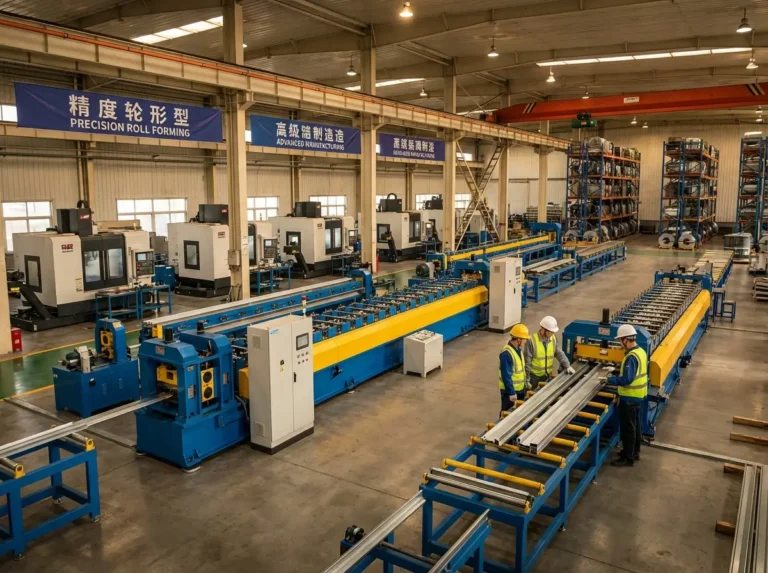
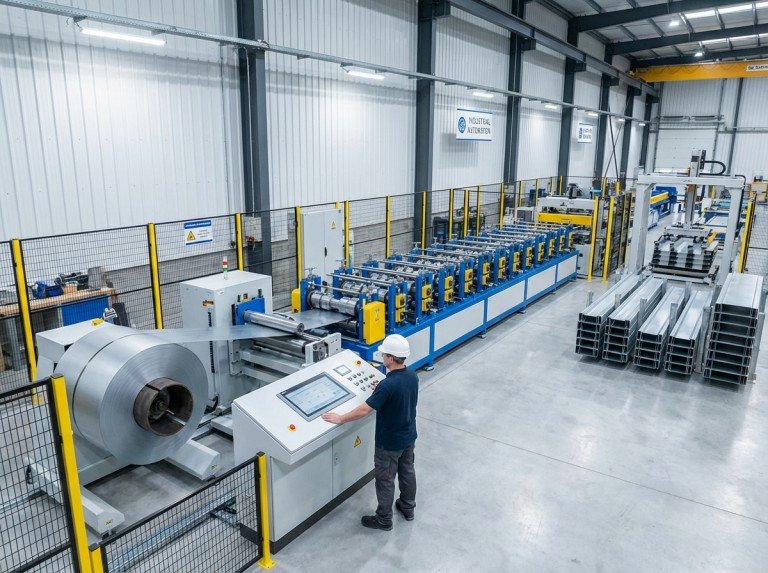
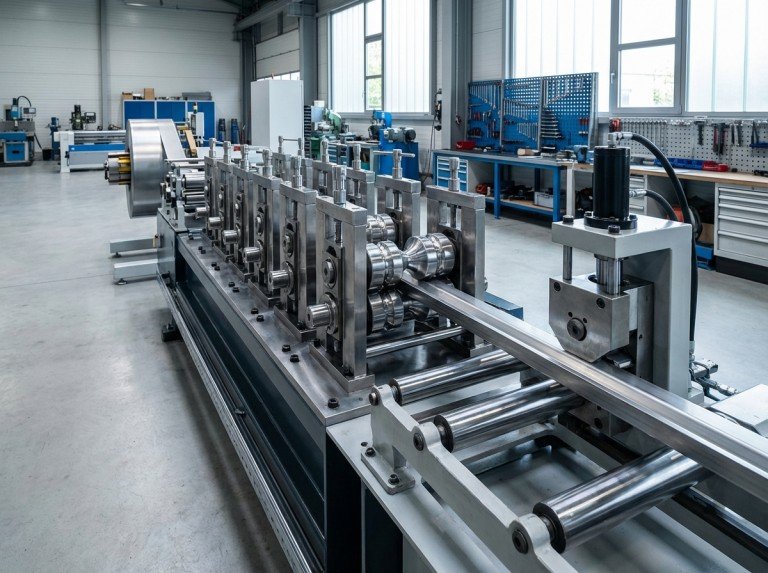
Cold roll forming machines are used to form high-strength steel components at room temperature, also known as cold rolling, and are often used to process long lengths of metal to produce a variety of metal products including (lift rails, shelving etc.). The cross-sectional profile of the cold roll forming machinery is usually tailored to the specific needs of the customer. The forming kun is used to control the localised processing of the material to prevent folding and wrinkling during the process. The machine is designed to meet the needs of metal bending.

What Cold Roll Forming Means?
A cold roll forming machine shapes a metal strip. It works continuously at room temperature. The strip passes through multiple roll stands to create a constant profile. This is different from cold rolling, which mainly reduces thickness. Cold rolling also improves flatness and surface finish. Cold roll forming focuses on shaping the strip. It makes channels, rails, frames, and other long parts.
I think of it as “progressive forming.” Each stand makes a small, controlled bend. This way, the profile reaches its final shape smoothly. It avoids harsh, single-step bending. That kind of bending can cause wrinkles, edge waves, or cracks.

How do roll forming machines work?
A cold roll forming line feeds a strip from a coil. It shapes the strip gradually, stand by stand. When the strip has the final profile, it is cut to length.
First, the coil is unwound. It is then guided into the forming section. Next, the strip passes through groups of roll stands. Each stand bends the metal a little more than the one before it. This process stabilizes the shape. Many lines can also run extra operations. These include punching, notching, and even welding. This means parts can be finished in a single pass.
The process happens at room temperature. This avoids heating steps and saves time. Production speeds often range from 30 to 600 feet per minute. This is especially true for high-volume and long-length parts.
Key Components
- Uncoiler + Coil Feeder:The uncoiler and feeder deliver the strip. They use controlled tension and alignment. Stable feeding reduces tracking errors. These errors can later appear as twist or camber.
- Roll Forming Stands :The roll forming stands do the shaping. The number of stands and the roll design are key. They decide if the profile forms smoothly or creates problems like wrinkles.
- Drive & Transmission :A consistent drive affects the final product. It impacts surface marks and thickness. It also ensures repeatability. If speed or torque changes, part dimensions can vary.
- Straightening/Guiding :Guides and straighteners help control the strip’s path. They also ensure the final part is straight. This is most important for long parts and complex profiles.
- Cutoff (Flying/Stop-to-Cut):The cutoff system determines length accuracy. It also affects the quality of the cut end. A flying cutoff allows for a continuous flow. A stop-to-cut system is simpler but interrupts production. The blade’s condition directly affects burrs on the cut edge.
- PLC + Sensors:A PLC control system standardizes key settings. This includes speed, length control, and cut timing. Sensors help with tracking, counting, and safety alarms.
- Optional In-line Units :Optional kits add more functions to the line. This allows it to finish more work in one pass. Common add-ons include logo printing, embossing, and punching units.
A cold roll forming machine is a system. Each section controls a different part of the process. These parts are quality, stability, and efficiency.

Main Types of Cold Roll Forming Machines
Single-Stand Roll Former
A single-stand machine uses one roll station. It creates basic bends or simple sections. It is a good fit for straightforward shapes and light forming jobs. However, it is limited. It is not ideal for complex profiles that need tight shape control. One station cannot spread the strain out gradually.
Multi-Stand Roll Former
A multi-stand roll forming machine uses many stations. It forms the metal progressively. This is the standard choice for industrial parts. It works well for rails, shelves, and cabinet frames. These parts need stable geometry. The main drawback is cost and setup time. More stands mean more design work and alignment points.
Continuous (In-line) Roll Forming Line
A continuous roll forming line combines forming with other jobs. These in-line operations can include punching or welding. The part is then cut to length at the end. This setup is best for high-volume production. You get a finished part in a single pass. It is less suited for frequent profile changes or small batches.
Machine type | Best for | Typical limitation |
|---|---|---|
Single-stand | Simple bends, low complexity | Limited shape control on complex sections |
Multi-stand | Most industrial profiles, better repeatability | More setup and alignment effort |
Continuous line | High volume + in-line processing | Changeover complexity if batches are small |
What is the difference between hot-rolled and cold-rolled?
The difference between hot rolling and cold rolling can be seen in the name. Hot rolling refers to the processing of metal materials manufactured in a heated environment, while cold rolling refers to the processing of metal materials at room temperature or close to room temperature, cold roll forming is obviously a more economical and efficient production method in terms of productivity.
Accuracy, Tolerances, and What Affects Them
Roll forming tolerances exist for a reason. Strip properties, springback, and tooling all cause variation. The practical approach is to define critical dimensions on a drawing. Then, control the process to meet those targets. Do not expect zero deviation.
Key factors that influence tolerance include material grade and thickness. Profile complexity, roll wear, and setup alignment also have an impact. When you buy a machine, I suggest you specify your needs. Call out critical widths, flange angles, and straightness requirements. Then, align the machine’s strategy to those targets.

The many benefits of roll forming machines
- Highly Customisable: different processing moulds can be used and logos can be printed on the surface during the process.
- Smooth Processing: the use of progressive processing does not damage the material and reduces the scrap rate.
- Long Processing Workpiece: the longest plus length of the profile processing is at 30 metres.
- Functional Versatility: equipped with a number of functions such as welding, bending, locking and punching.
- High Production Speed: 30-600 feet per minute production speed, extremely high production efficiency.
- High Precision: PLC control is used, which greatly improves the machining precision of the parts.
How to keep the forming machine working properly?
Keeping a cold roll forming machine stable is simple. It is mostly about cleanliness, lubrication, and inspection. Rollers should be kept clean and protected from rust. Lubricate them according to the machine’s manual.
Here is a practical maintenance rhythm I use as a baseline:
- Daily: Clean debris. Check for odd noises or vibrations. Verify guards and sensors. Confirm the lubrication system is working.
- Weekly: Inspect roll surfaces, guides, and fasteners. Check the cutoff area for wear.
- Monthly (or by hours): Verify alignment points. Check for transmission wear. Review PLC alarms. Recalibrate length control if needed.
If you skip maintenance, problems will appear. The first signs are often twist, drifting angles, and inconsistent length. You will not see a total machine failure right away.
Conclusion
A cold roll forming machine is the best way to make long metal profiles. It produces repeatable, constant cross-sections at room temperature. Understand the process flow. Match the right machine to your volume. Treat tolerances as something to control, not wish away. This will give you stable quality and high output.
At Co-effort, I focus on making the line behave predictably. This means stable feeding, progressive forming, and controlled cutoff. It also means using maintenance to prevent problems before they start.
FAQ
Is a cold roll forming machine the same as a cold rolling machine?
No. Cold roll forming shapes a profile. Cold rolling mainly reduces thickness and improves the surface. Both work at room temperature, but their goals are different.
Can a cold roll forming line do punching or embossing in the same pass?
Yes, many lines support in-line operations. This can include punching, notching, or embossing. Feasibility depends on the profile, station layout, and process control.
Why do wrinkles or folds happen during roll forming?
Wrinkles usually come from a poor forming sequence. Unstable guiding or an incorrect strip width can also cause them. The fix is often to optimize the alignment and sequence, not to use more force.
What determines roll forming tolerances most?
Material behavior and machine setup have the biggest impact. Variation in grade or thickness matters. Springback, roll wear, and alignment drift also affect final dimensions.
How long can roll formed parts be?
Long parts are a strength of roll forming. Lengths up to about 30 meters are common. The main limits are support tables, straightness control, and safe handling.